
UDID card: what it is, its benefits and how to apply
The national disability ID, explained step by step, with a summary in Hindi
In short: A UDID (Unique Disability Identity) card is the Government of India's national disability ID. The district's medical authority issues it, together with an online disability certificate, after an assessment. Any Indian citizen with a full or partial disability can apply on swavlambancard.gov.in with a photo, Aadhaar and address proof. The card is accepted as proof of disability for government schemes.
What is a UDID card? (UDID full form)
UDID stands for Unique Disability Identity. The project, run by the Department of Empowerment of Persons with Disabilities, builds a national database of people with disabilities. Each person gets a disability certificate and a UDID card through one online portal, issued by the medical authorities each state or union territory has notified.
Since 1 June 2021, medical authorities may issue disability certificates and UDID cards only through this portal. If you have an older paper certificate, apply on the portal and say you already have a certificate; the medical authority decides whether you need to be assessed again.
Benefits of a UDID card
- It is accepted by the Government of India as proof of disability for schemes and benefits, including financial help, healthcare, education and employment.
- It is needed for the ADIP scheme, which pays for hearing aids and other aids. For a repeat ADIP benefit, only the UDID number is needed.
- Under a department order of 18 September 2024, the UDID number alone is enough for the department's scholarships and free coaching, fee concessions at its national institutes and regional centres, and its other schemes.
- Since 1 January 2023, UDID holders pay no registration or diagnostic fees at the department's national institutes and Composite Regional Centres, whatever their percentage of disability.
- One unique ID for easy identification, and a certificate that, under the RPwD Act, is valid across India.
- The card and certificate are linked to DigiLocker, so you can show them on your phone.
UDID card colours
| Colour | Percentage of disability |
|---|---|
| White | Below 40% |
| Yellow | 40% up to 79% |
| Blue | 80% and above |
Cards are permanent or temporary. A temporary card is renewed from your dashboard on the portal. In July 2024 the department told states not to refuse a certificate or UDID card to people assessed below 40%.
Who issues it and who can apply
The card is issued by the district's competent medical officer: the CMO, CHMO, CDMO, Civil Surgeon or equivalent. Any citizen of India with a full or partial disability can apply. The portal recognises 21 disabilities, the ones listed in the RPwD Act, 2016.
Documents needed
- A recent colour photograph (15 to 100 KB) and your signature (3 to 30 KB).
- Aadhaar details. Aadhaar is mandatory.
- Proof of address (10 to 500 KB).
- Your existing disability certificate, if you have one (10 to 500 KB).
How to apply for a UDID card
- Fill in and submit the application on swavlambancard.gov.in, choosing the hospital where you will be assessed.
- You get an SMS with your assessment date and hospital. There is no fixed timeline for this.
- Go to the UDID or disability certification section of that hospital on the date given.
- Specialist doctors assess you, and a medical board decides the type and percentage of disability.
- The medical authority generates your disability certificate and UDID card, and the department sends the card to you by Speed Post.
Status, download and lost cards
- Status: use Track Your Application with your enrolment number, UDID number, mobile number or Aadhaar number.
- Download: log in to the PwD dashboard on the portal to download your e-UDID card and e-disability certificate, or get them from DigiLocker.
- Changes: you can update your mobile number and email yourself; address, date of birth, gender and parent's name through Aadhaar e-KYC; your name and Aadhaar number only through the hospital.
- Lost card: apply for "Lost Card/Card Not Received" on your dashboard.
- Help: 011-24365019 or disability-udid@gov.in.
How hearing disability is measured
The guidelines notified on 14 March 2024 set how a medical board measures hearing disability. The board includes an ENT specialist and an audiologist or speech-language pathologist.
- An audiologist tests each ear separately with pure-tone audiometry. If the results are not reliable, other tests (immittance, speech audiometry, ABR or ASSR) are used. Children aged 3 to 5 have play-based tests.
- For each ear, the average loss at 500, 1000, 2000 and 4000 Hz is converted to a percentage. For example, an average of 25 dB or less is 0%, 60 dB is 40%, 70 dB is 57.1%, 80 dB is 74.2% and 95 dB (or no response) is 100%.
- The two ears are combined: hearing disability % = (better ear % × 5 + poorer ear %) ÷ 6.
- Example: 60 dB in the better ear (40%) and 80 dB in the poorer ear (74.2%) gives (200 + 74.2) ÷ 6 = 45.7%.
- Permanent conductive or mixed hearing loss is assessed only if hearing has not improved six months after treatment, or after using a suitable hearing aid.
This is why the better ear matters most: an average loss of about 60 dB in the better ear is roughly where hearing loss reaches the 40% needed for ADIP and most other schemes.
UDID कार्ड क्या होता है?
UDID का पूरा नाम Unique Disability Identity Card (विशिष्ट दिव्यांगता पहचान पत्र) है। यह भारत सरकार के दिव्यांगजन सशक्तिकरण विभाग की पहल है। जिले के सक्षम चिकित्सा अधिकारी (CMO, सिविल सर्जन या समकक्ष) जाँच के बाद ऑनलाइन दिव्यांगता प्रमाण पत्र और UDID कार्ड जारी करते हैं।
- कौन आवेदन कर सकता है: पूर्ण या आंशिक दिव्यांगता वाला कोई भी भारतीय नागरिक।
- ज़रूरी दस्तावेज़: रंगीन फोटो, आधार, पते का प्रमाण, और पुराना दिव्यांगता प्रमाण पत्र (अगर है)।
- आवेदन कैसे करें: swavlambancard.gov.in पर आवेदन भरें। SMS में बताई गई तारीख पर चुने हुए अस्पताल जाएँ। मेडिकल बोर्ड जाँच करके दिव्यांगता का प्रकार और प्रतिशत तय करता है, और कार्ड स्पीड पोस्ट से भेजा जाता है।
- कार्ड के रंग: 40% से कम सफेद, 40% से 79% पीला, 80% या उससे अधिक नीला।
- फायदे: सरकारी योजनाओं में दिव्यांगता के प्रमाण के रूप में मान्य, जैसे ADIP योजना में मुफ्त या रियायती सहायक उपकरण (जैसे कान की मशीन), विभाग की छात्रवृत्ति, और राष्ट्रीय संस्थानों में पंजीकरण और जाँच शुल्क में छूट।
- हेल्पलाइन: 011-24365019, ईमेल disability-udid@gov.in
Frequently asked questions
What is the full form of UDID?
What are the benefits of a UDID card?
Is Aadhaar mandatory for a UDID card?
How long does it take to get a UDID card?
How can I download my UDID card?
Does a UDID card replace the disability certificate?
UDID card kya hota hai?
Official sources
- UDID portal frequently asked questions
- Apply for UDID
- Track your UDID application
- UDID page, Department of Empowerment of Persons with Disabilities
- Guidelines for assessing specified disabilities (S.O. 1338(E), 14 March 2024)
- DEPwD advisory to states, 5 July 2024
- DEPwD order of 18 September 2024 on the UDID number for benefits
Checked against these sources on 13 November 2026. Government rules and portals change, so check the official site before you apply. ÖSEL Foundation is a non-profit, not a government office: we cannot approve or track applications, but we are happy to point you in the right direction.
More free guides
Need help with a hearing problem?
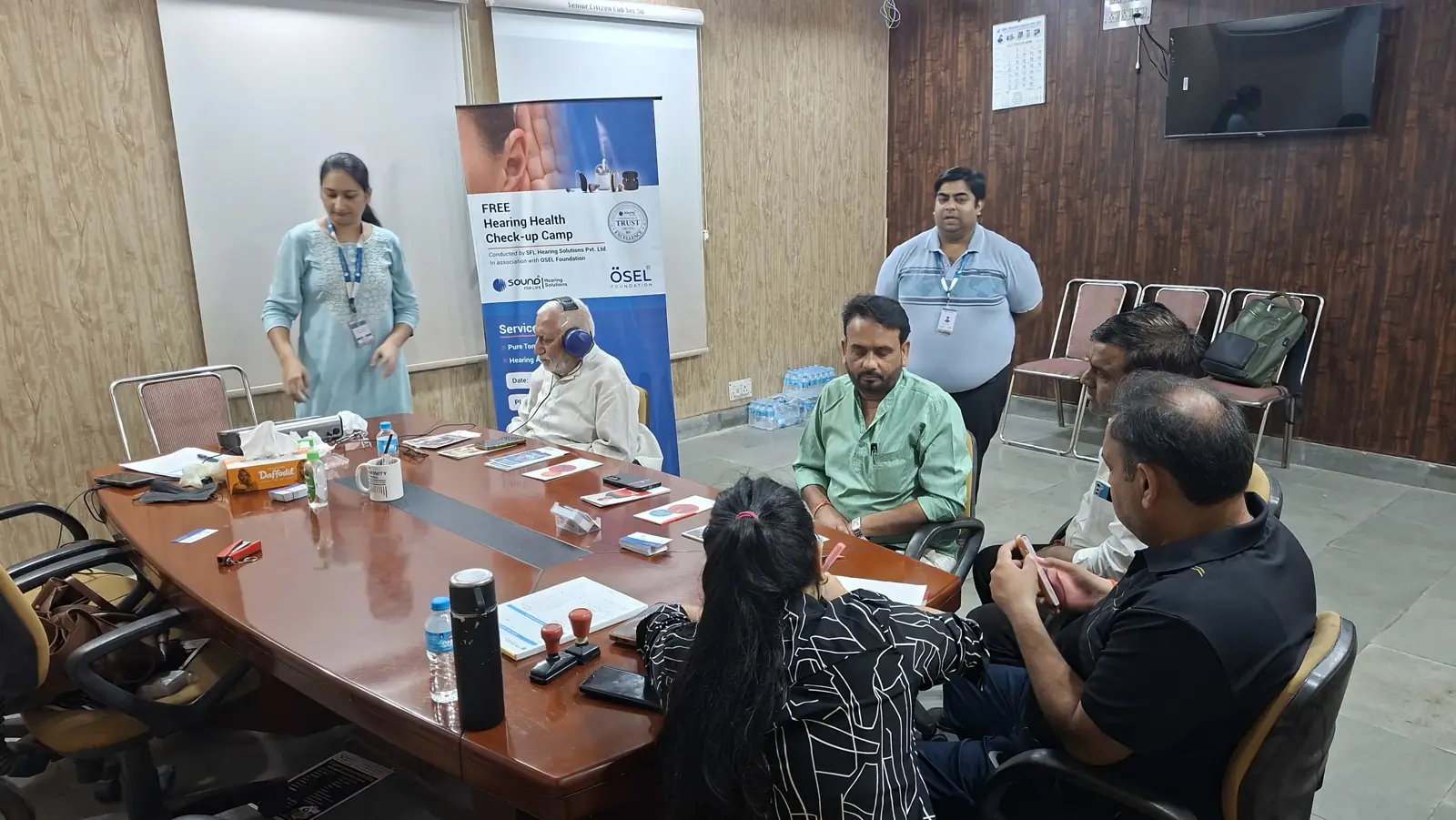
ÖSEL Foundation runs free hearing screening camps with resident welfare associations, senior citizens' clubs and community groups across Delhi NCR. If you, a parent or a neighbour cannot hear well, come to a camp or ask us to hold one in your society.