
ADIP scheme: free hearing aids and other aids for people with disabilities
Who qualifies, what it pays for and how to apply, checked against the official guidelines
In short: ADIP is a Government of India scheme, running since 1981, that pays for aids and appliances such as hearing aids for people with at least 40% disability. If your monthly income is up to ₹22,500 it pays the full cost; from ₹22,501 to ₹30,000 it pays half. You need a UDID card (or UDID enrolment number) and Aadhaar, and you apply on the ARJUN portal (adip.depwd.gov.in) or at an assessment camp.
What is the ADIP scheme? (ADIP full form)
ADIP stands for Assistance to Disabled Persons for Purchase/Fitting of Aids and Appliances. Its current official name is the Scheme of Assistance to Persons with Disabilities for Purchase/Fitting of Aids/Appliances. It is run by the Department of Empowerment of Persons with Disabilities (DEPwD), Ministry of Social Justice and Empowerment, and helps people with disabilities get durable, modern aids that improve their independence.
The current guidelines apply from 26 September 2024. They are the version to rely on: an older April 2024 version is still hosted on the ARJUN portal, and some of its rules have changed.
Who is eligible for ADIP?
Under the 26 September 2024 guidelines, you can get help under ADIP if you are:
- An Indian citizen of any age.
- Holding a UDID card, or a UDID enrolment number together with a disability certificate showing at least 40% disability. See our UDID card guide if you do not have one yet.
- Able to give an Aadhaar number (or an Aadhaar enrolment ID with the other documents the Aadhaar Act allows).
- Earning not more than ₹30,000 a month from all sources. For a child or other dependant, the parents' or guardian's income must be within ₹30,000 a month.
- Not given the same aid in the last 3 years from any source. For children under 18, the gap is one year.
For hearing loss, 40% disability means roughly an average loss of 60 dB or more in the better ear on a pure-tone hearing test. The medical board works out the exact percentage with a fixed formula, explained in our UDID guide.
How much does ADIP pay?
| Monthly income | Help under ADIP |
|---|---|
| Up to ₹22,500 | Full cost of the aid |
| ₹22,501 to ₹30,000 | 50% of the cost of the aid |
| Above ₹30,000 | Not eligible |
- Aids costing up to ₹15,000 are covered in full (within your income slab). For aids costing ₹15,001 to ₹30,000 the scheme pays up to ₹15,000, and the rest can come from CSR funds, MPLAD, the state government or the beneficiary.
- The amount paid is the scheme limit or the listed maximum price of the aid, whichever is lower.
- If your income is up to ₹22,500, the scheme also pays travel up to ₹250 for you and one escort, and ₹100 a day (for up to 5 days) for boarding while an ear mould is fitted.
- Up to ₹1,500 can go towards a small surgical correction needed before a hearing aid is fitted.
Hearing aids under ADIP
The official list of aids (applying from 1 July 2024) sets these maximum prices for hearing aids. All are behind-the-ear (BTE) models; the list does not include in-the-ear or receiver-in-canal aids.
| Hearing aid (behind the ear) | Degree of hearing loss | Maximum price |
|---|---|---|
| Non-programmable (ISI standard IS:16127) | Mild, moderate or severe | ₹4,500 |
| Programmable | Moderate or severe | ₹4,500 |
| Digitally programmable | Profound | ₹10,000 |
Each hearing aid comes with three sets of ear tips and tubes, 36 batteries and a manual in Hindi and English. Students who have passed Class 10 can also get a smartphone (up to ₹12,000, once in five years).
Cochlear implants for children
ADIP lists up to ₹7 lakh per implant for children aged 1 to 5 with hearing loss from birth (pre-lingual), and up to ₹6 lakh for children aged 5 to 18 who lost their hearing later. The amount covers the implant, surgery, mapping, therapy and travel, and three years of auditory-verbal therapy are compulsory. The Ali Yavar Jung National Institute of Speech and Hearing Disabilities (AYJNISHD), Mumbai, runs this part.
Check before you plan on this route. At the Central Advisory Board on Disability meeting in January 2026, a member said no cochlear implant surgeries had been done under ADIP for the past two years, and the department said it was reviewing the programme. Ask AYJNISHD whether implants are being done now.
Documents you need
- UDID card, or UDID enrolment number plus a disability certificate showing at least 40%.
- A copy of your Aadhaar.
- Proof of income: an income certificate from the revenue department, BPL card, MGNREGA card, disability pension card, or a certificate from your MP, MLA, councillor or gram pradhan. If you have none of these, a self-declaration or notarised affidavit is accepted.
- Address proof, such as Aadhaar, voter ID or ration card.
- An undertaking that you have not received the same aid in the last 3 years.
If you have had an ADIP aid before, a department order of 18 September 2024 says only your UDID number is needed for a repeat benefit.
How to apply for ADIP
Online on the ARJUN portal
ARJUN (ADIP and RVY Joint Interface for Unique Nomination) is the government's portal for ADIP and for the Rashtriya Vayoshri Yojana. Under the guidelines, every assessment and distribution is recorded on it.
- Open the ARJUN portal (adip.depwd.gov.in) and choose Beneficiary Registration, then Signup/Registration.
- Enter your mobile number, choose ADIP and verify with the OTP.
- Enter your UDID number or UDID enrolment number and date of birth. If you have neither, the portal sends you to swavlambancard.gov.in first. Wait at least one day after your UDID enrolment before registering on ARJUN.
- Pick the nearest centre and the aid you need, and enter your Aadhaar number.
- You get a registration number by SMS, with the list of documents to bring.
- Visit the centre with your documents for assessment. A rehabilitation professional checks you and the aid is handed over; repairs later are done at AASRA centres.
Under the guidelines, aids for people who register on ARJUN are to be given within 6 months of registration.
At a camp or centre
You can also go to an implementing agency, such as ALIMCO, a national institute, a Composite Regional Centre (CRC) or a District Disability Rehabilitation Centre (DDRC), or attend an ADIP assessment camp in your district. Distribution camps follow the assessment camps.
By letter
The ARJUN FAQ also accepts a request letter with documents sent to the Department of Empowerment of Persons with Disabilities, Pt. Deendayal Antyodaya Bhawan, 5th floor, CGO Complex, Lodhi Road, New Delhi 110003.
Check the status of your ADIP application
Keep the registration number from your SMS. The ARJUN home page has a Check Covered Beneficiaries option, and the helplines are 011 24369027 (ARJUN) and 1800 180 5129 (ALIMCO, toll-free). For repairs or a replacement, contact the agency that gave you the aid.
Where the scheme stands in 2026
The department's ADIP page says the scheme was last revised from 26 September 2024 and approved until 31 March 2026, the end of the 15th Finance Commission period. As of 13 November 2026 that page lists no newer continuation order. In a Lok Sabha answer on 28 July 2026, the government described ADIP as running, with the same income limits. Check the ARJUN portal or the helpline for the current position before you apply.
Frequently asked questions
What is the full form of ADIP?
Is a hearing aid free under the ADIP scheme?
Do I need a UDID card for ADIP?
How do I apply for ADIP online?
How long does ADIP take?
Can I get a hearing aid again under ADIP?
Does ÖSEL Foundation give ADIP hearing aids?
Official sources
- ADIP scheme guidelines applicable from 26 September 2024 (DEPwD)
- ADIP scheme page, Department of Empowerment of Persons with Disabilities
- Comprehensive list of aids and appliances with maximum prices (from 1 July 2024)
- ARJUN portal
- ARJUN frequently asked questions
- ARJUN user manual
- DEPwD order of 18 September 2024 on the UDID number for benefits
- Lok Sabha answer on ADIP, 28 July 2026
- Minutes of the 8th Central Advisory Board on Disability meeting (January 2026)
Checked against these sources on 13 November 2026. Government rules and portals change, so check the official site before you apply. ÖSEL Foundation is a non-profit, not a government office: we cannot approve or track applications, but we are happy to point you in the right direction.
More free guides
Need help with a hearing problem?
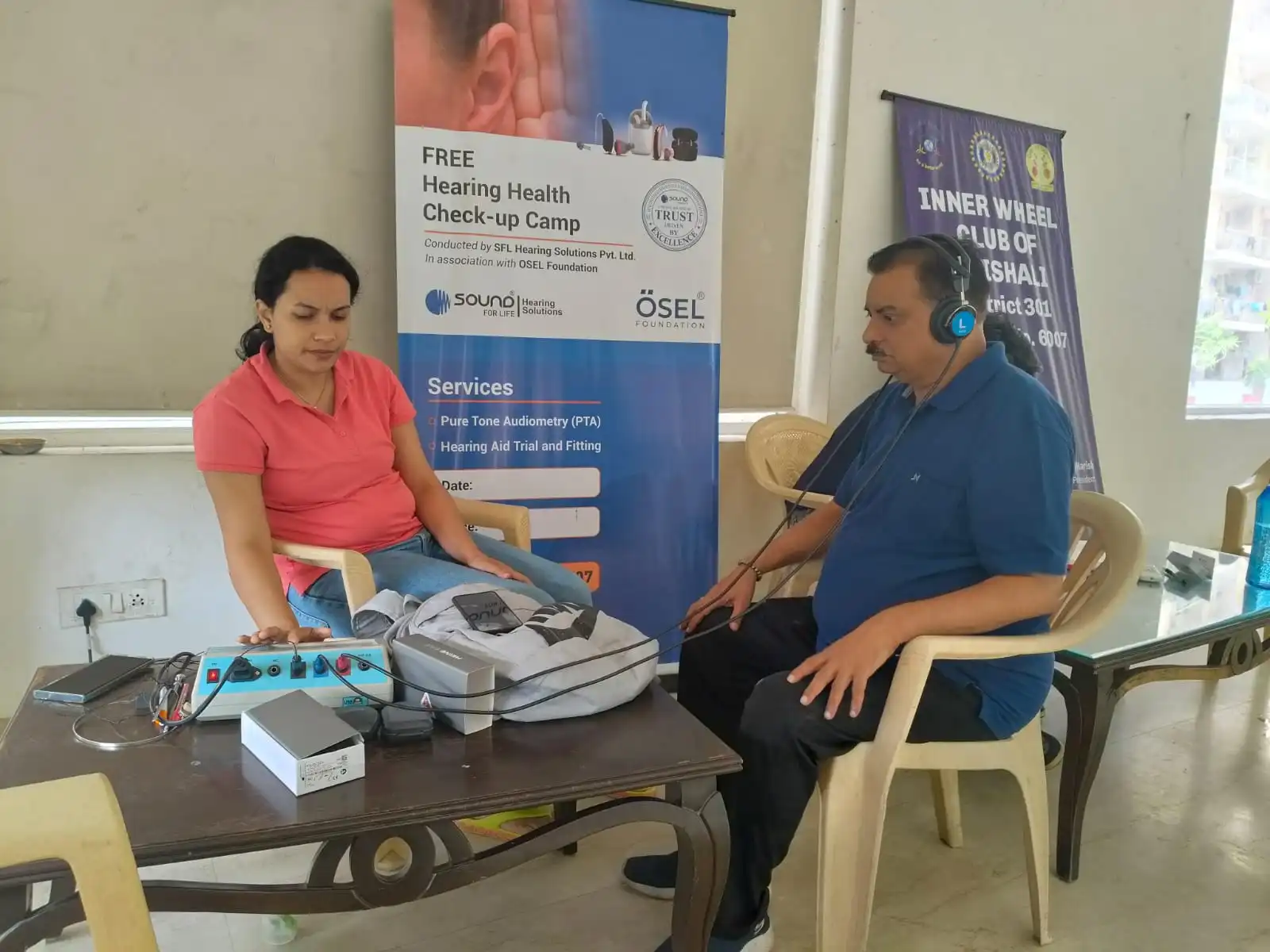
ÖSEL Foundation runs free hearing screening camps with resident welfare associations, senior citizens' clubs and community groups across Delhi NCR. If you, a parent or a neighbour cannot hear well, come to a camp or ask us to hold one in your society.