
The RPwD Act, 2016 explained in plain English
What India's disability law says, and what it means for people with hearing loss
In short: RPwD stands for Rights of Persons with Disabilities. The RPwD Act, 2016 (Act No. 49 of 2016) is India's main disability law. It came into force on 19 April 2017, replacing the Persons with Disabilities Act, 1995. It recognises 21 disabilities, defines a "benchmark disability" as at least 40%, and gives rights in education, jobs, healthcare and access to aids.
RPwD full form and key dates
- Full name: The Rights of Persons with Disabilities Act, 2016.
- Act number: Act No. 49 of 2016.
- President's assent: 27 December 2016; published in the Gazette of India on 28 December 2016.
- In force: 19 April 2017, replacing the Persons with Disabilities Act, 1995.
Read the official text: RPwD Act, 2016 (PDF, Gazette of India copy hosted by DEPwD).
The 21 specified disabilities
The Act's Schedule lists these specified disabilities, and the Central Government can notify more:
- Locomotor disability
- Leprosy cured persons
- Cerebral palsy
- Dwarfism
- Muscular dystrophy
- Acid attack victims
- Blindness
- Low vision
- Deaf
- Hard of hearing
- Speech and language disability
- Intellectual disability
- Specific learning disabilities
- Autism spectrum disorder
- Mental illness
- Multiple sclerosis
- Parkinson's disease
- Haemophilia
- Thalassemia
- Sickle cell disease
- Multiple disabilities, including deaf-blindness
Hearing impairment under the Act
- Deaf: a hearing loss of 70 dB in the speech frequencies in both ears.
- Hard of hearing: a hearing loss of 60 dB to 70 dB in the speech frequencies in both ears.
- Speech and language disability is a separate category.
How a medical board turns a hearing test into a percentage is explained in our UDID card guide.
"Are you a person with disability?" What benchmark disability means
Job and college forms often ask whether you are a person with (benchmark) disability. Under section 2(r) of the Act, a person with benchmark disability has at least 40% of a specified disability, as certified by the certifying authority. Most reservations and scheme benefits in the Act apply to benchmark disability, so you need a disability certificate, now issued with a UDID card, to claim them. Under section 58(3), that certificate is valid across the country.
Rights that matter for people with hearing loss
- Government jobs (section 34): at least 4% of vacancies in each group of posts are reserved for people with benchmark disabilities, of which 1% is for people who are deaf or hard of hearing.
- Higher education (section 32): government and government-aided colleges reserve at least 5% of seats, with five years' relaxation in the upper age limit.
- Free education (section 31): every child with a benchmark disability aged 6 to 18 has the right to free education in a neighbourhood school or a special school of choice.
- Sign language and communication (section 16): education for deaf persons must be given in the most appropriate languages, modes and means of communication.
- Aids and appliances (section 24): government schemes must provide aids and appliances free of cost within notified income limits, such as the ADIP scheme.
- Healthcare (section 25): free healthcare nearby within notified family-income limits, and screening of all children at least once a year to identify those at risk.
- No discrimination at work (section 20): government establishments cannot discriminate in employment and must provide reasonable accommodation.
- Private employers (section 35): incentives for employers whose workforce includes at least 5% people with benchmark disabilities.
- Appeals (section 59): you can appeal against a decision of the certifying authority.
Where to get help
For a certificate, apply for a UDID card. For a hearing aid, look at the ADIP scheme or, for people aged 60 and over, the Rashtriya Vayoshri Yojana. This page is general information, not legal advice.
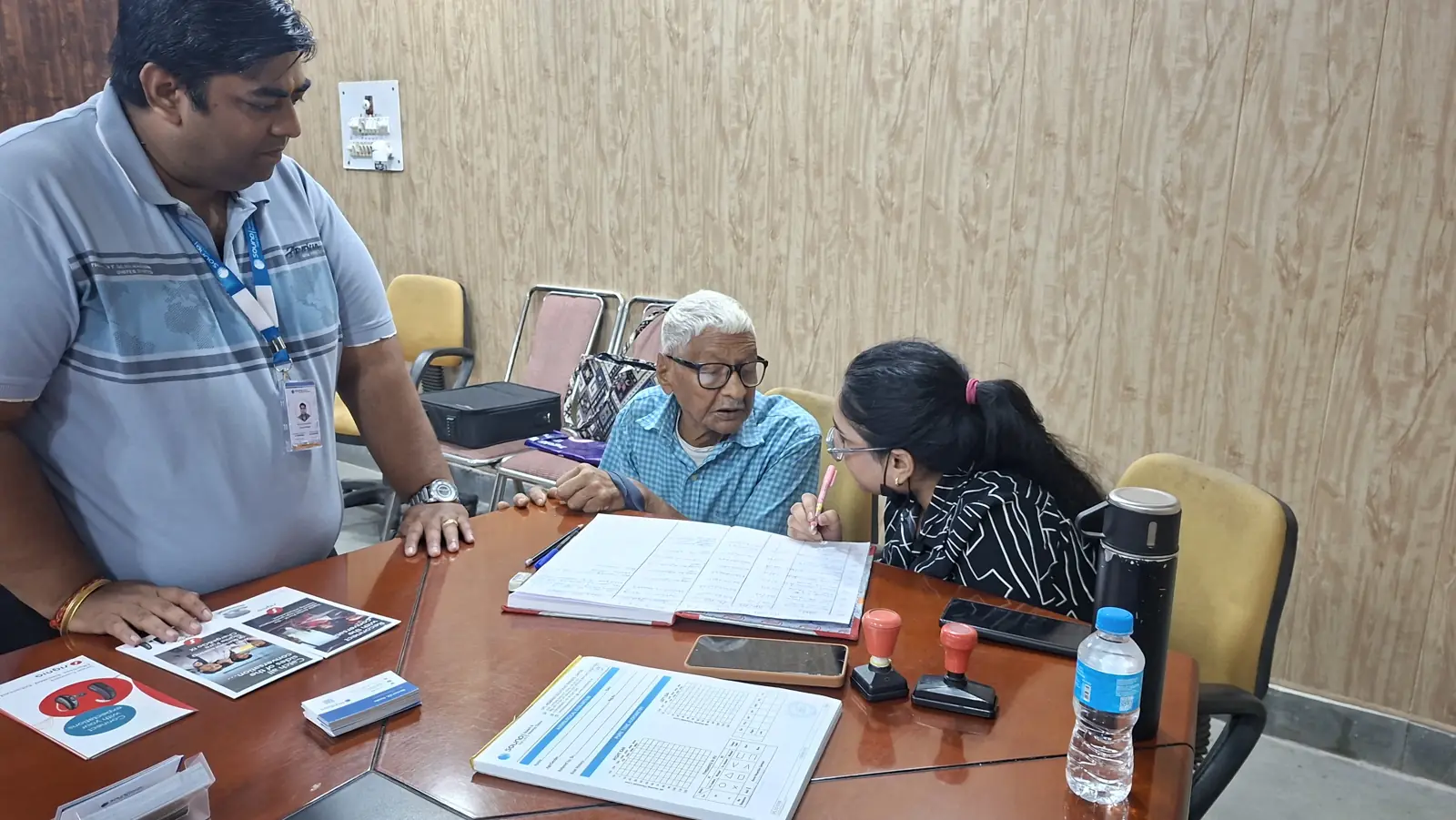
ÖSEL Foundation is a non-profit, not a government office, and does not process scheme applications. At our free hearing screening camps an audiologist can check your hearing and explain the result, which is a useful first step before you apply.
Frequently asked questions
What is the full form of RPwD?
When did the RPwD Act come into force?
How many disabilities are covered under the RPwD Act, 2016?
What is benchmark disability?
What is the reservation for deaf and hard of hearing people in government jobs?
Where can I download the RPwD Act, 2016 PDF?
Official sources
- The Rights of Persons with Disabilities Act, 2016 (Gazette of India copy, DEPwD)
- Acts page, Department of Empowerment of Persons with Disabilities
- PIB backgrounder on disability rights, 5 October 2024
- Guidelines for assessing specified disabilities (14 March 2024)
- UDID portal frequently asked questions
Checked against these sources on 13 November 2026. Government rules and portals change, so check the official site before you apply. ÖSEL Foundation is a non-profit, not a government office: we cannot approve or track applications, but we are happy to point you in the right direction.
More free guides
Need help with a hearing problem?
ÖSEL Foundation runs free hearing screening camps with resident welfare associations, senior citizens' clubs and community groups across Delhi NCR. If you, a parent or a neighbour cannot hear well, come to a camp or ask us to hold one in your society.